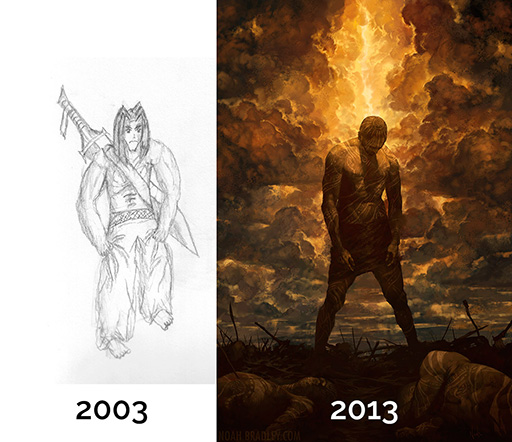
I will teach you to be a better artist.

That's the promise I made to students years ago when I launched Art Camp. Since then thousands of artists have taken these courses and become better artists.

120-day guarantee. No questions asked.

I'm thrilled to offer over 100 hours of fully narrated videos on how to make better work. These courses are the sum total of my knowledge on how to train artists.

I'm so confident in all of the material that I absolutely guarantee that you'll enjoy it and learn to make better art. Everything is covered by a 100%, no-questions-asked money-back guarantee. That means you kinda can't go wrong by giving it a shot.

Got questions? Reach out to help@artcamp.com

Stay awesome,

Noah Bradley

Founder, Artist, Teacher · noahbradley.com · YouTube

…that habit landed me a few jobs in the animation industry…Gabriela Birchal

…quit my 9 to 5 job and live entirely on the income I earn from being a freelance artist…Dylan Burss

…Art Camp 1 taught me how to learn…Chase Henson

So what exactly is Art Camp?

Art Camp is a collection of 12-week self-directed online courses designed to give you the most progress for the time you put into it.

While watching endless tutorial videos is great, Art Camp is all about giving you a structure to your education. These are the exact exercises you can use to improve your skills as an artist, no matter where you're at right now. Whether you're a beginner or a pro, these courses will push you to the next level.

If you do these exercises, you will improve. I promise.

Watch the first demo for Art Camp 1 right now for free

“Art Camp was a great course for me. It taught me new ways to study and improve at art, and I use some of the exercises I learned during the course to this day. It also helped me feel more confident about drawing and painting backgrounds and that habit landed me a few jobs in the animation industry. I'm very grateful for everything that I learned with Noah Bradley.”
Gabriela Birchal
“Art Camp has helped me become a better artist in every way possible. Noah Bradley is one of the finest artist and art teachers working today, and I say that with the utmost sincerity. Noah Bradley's lessons are truly one of a kind because he always has something important to say while he's painting a breathtaking landscape right before your very eyes. When I first started Art Camp within a year I was able to quit my 9 to 5 job and live entirely on the income I earn from being a freelance artist. Art Camp gave me that confidence.”
Dylan Burss

Curriculum

Three 12-week courses. Same weekly rhythm: watch the demo, then do the work that fits your week.

Art Camp 1

Perfect for beginners. The best exercises and thought processes to grow into a better artist.

  1. 01 Master studies

    Learn how to steal their secrets and do focused master studies.

  2. 02 Sketching from Imagination

    Too many people lose sight of how to apply the knowledge they learn. That's why we're starting with imaginative painting so early. Education without application is useless.

  3. 03 Still Life

    One of the best ways to practice technique and learn to render objects. They have the advantage of never moving and giving you unlimited time to refine and study.

  4. 04 Self Portraits

    Learning to paint a face requires painting a lot of faces. One of the easiest ways to do this is self-portraits, as you never have to worry about finding a willing model.

  5. 05 Plein Air

    Getting outside to work is a wonderful way to study both people as well as the natural world. Let's get into the habit of leaving our studios.

  6. 06 Learning from Photos

    Photos are easily available but can cause extremely harmful habits if used incorrectly. I'll show you how to learn from photo reference without harming your skills.

  7. 07 Materials & Edges

    There are many different types of materials in the world, things like cloth, silk, metal, rock, flesh, and all of them require slightly different treatments. We'll learn how light affects them differently and how to use edges to convey texture.

  8. 08 Drawing & Painting Figures

    The human form is one of the most beautiful and challenging subjects that we can paint. This week we'll go over useful exercises, approaches, and resources for drawing and painting figures.

  9. 09 Concept Art & Ideation

    We'll go over the basics of developing original concepts in our work. Even if you want to pursue another field, the ability to come up with unique concepts and ideas is critical in art.

  10. 10 Composition & Thumbnailing

    This week we will learn how to create striking, dynamic compositions as we begin to develop a finished portfolio piece to wrap up the course.

  11. 11 Color & Light

    Using the portfolio piece we are creating as a base, we will explore the world of color and light and learn how to use them to convey emotion.

  12. 12 Finishing

    Many of us struggle with finishing work. We can start a piece, but have no idea how to finish our work. This week I'll go over the techniques and approach I take in finishing my work.

Art Camp 2

Expand your horizons and try totally new techniques and materials.

  1. 01 Seeing & Drawing

    Learn to train your eye with basic drawing and observation techniques. These are the basics that everything else is built on.

  2. 02 Keeping a Sketchbook

    Sketchbooks are the birthplaces of paintings. Learn to develop the habit of continual sketching and observation.

  3. 03 Practical Perspective

    That thing everyone hates. I'm going to break down perspective to the basics of what you need to learn and explain it as clearly as possible. Don't be afraid. It's not that scary.

  4. 04 Drawing Material Experiments

    Learn to play around with new materials in drawing. We'll cover charcoal, graphite, pastel, ink, and perhaps others in an attempt to see what these mediums can offer us.

  5. 05 Painting Materials & Techniques

    Most people paint digitally because they think traditional painting is expensive or complicated. But I'll show you how to do it. I promise you'll love it.

  6. 06 Digital Painting Basics

    I'm going to show you every trick, tool, and method I know for working digitally. Specifically designed for working in Photoshop.

  7. 07 Light & Form

    Learning to draw and paint basic forms is a cornerstone of learning any new medium. These fundamental exercises will push our facility to the next level.

  8. 08 Narrative & Storytelling

    Learn to communicate compelling narrative in visual and written form. Let's dive into the art of storytelling.

  9. 09 Sequential Images

    Storyboards, comics, and other sequential art. Learn the freedoms and challenges that come with working with multiple images.

  10. 10 Photography & Using Reference

    Get out your cameras. I'm going to show you how to use photography to improve your other artistic skills. Also we'll be talking about shooting good reference and using it effectively.

  11. 11 Sculpture

    Learn to think entirely differently. Working in three dimensions will radically change how you approach your drawings. Trust me, you don't want to miss this.

  12. 12 Developing Style & Creating Work You Love

    How to find your style and do work that you love.

Art Camp 3: Landscapes

Everything I know about painting landscapes.

  1. 01 The Fundamentals of Landscapes

    The ultimate primer on landscapes. Avoid the most common mistakes and learn the basic knowledge that will easily set your landscapes apart.

  2. 02 Studying the Masters

    In Art Camp tradition, we're going to be looking back at the old masters. This time we'll be looking at and studying their work through the lens of landscapes, and digging into the specifics of why they were great.

  3. 03 Forms of Nature 1: Ground, Rocks, and Trees

    The building blocks of most landscapes. Study their forms and learn them like you never have before. Think of this like the anatomy of landscapes.

  4. 04 Forms of Nature 2: Skies, Clouds, and Mountains

    If last week was studying the midground, this week we're tackling the background. We'll continue to strive to understand form so we can avoid flat, boring landscapes.

  5. 05 Seeing Color & Light

    See and understand the essential lighting schemes in landscapes and learn how to replicate them.

  6. 06 Thumbnailing for Landscapes

    Beginning with observational thumbnails before shifting into more imaginative work, we'll closely analyze the unique compositional challenges and advantages in landscape painting.

  7. 07 Creating Light

    Lighting is one of the best ways to make a landscape interesting. Learn to create amazing, interesting, unique lighting in your work.

  8. 08 Climate & Weather

    From a sweeping tundra to a lush rainforest, and from a barren desert to a snow capped mountain, we'll look at the best ways to capture these unique vistas.

  9. 09 Narrative & Emotions in Landscapes

    I mistakenly thought for years that landscapes couldn't possibly have emotion, and how wrong I was. This week we'll see how we can create a story or a feeling with just a landscape.

  10. 10 Finished painting: Painterly Approach

    An extended demo of a fully finished landscape piece, showing off a painterly approach and finish. For this and the remaining weeks, all work will be shown. From first marks to the last, you'll see exactly how it's done.

  11. 11 Finished painting: Photobashing

    Another finished painting, this time utilizing photos both as reference as well as placed directly into the piece to speed up production time.

  12. 12 Finished painting: Incorporating 3D

    See how to use 3d tools to make better work, faster. See how to make these tools work for you, and not the other way around.

“Written words wouldn't do it justice. Not even close. If I had to try? Art Camp 1 taught me how to learn. Art camp 3 is teaching me how to live.”
Chase Henson

So what's my experience going to be?

Every week you'll login to the site here and watch a 2 hour demo video showing how to do the assignment, what you should be thinking about, and how to get the most out of the assignments.

Then you'll start to dive into that week's assignments, whatever they might be. If you get stuck, want to take a break, or have something to share, you can hop in the group chat with all of the other Art Camp students.

What you actually get.

120-day money-back guarantee

No, really, for any reason. I promise. I never want someone's money unless they loved the experience and thought it was worth every dime.

A supportive artistic community

I have been blessed to witness a thriving community blossom around Art Camp. The group chat is how we talk now.

Structure that fits your life

There's a structure to the course, but it's designed to be flexible. Tiered assignments for every kind of student.

Hours of narrated demos

Each course ends up with over 24 hours of demo material, plus bonuses, critique videos, or Q&A. Download everything DRM-free.

Peer-to-peer feedback

A private Discord channel. No matter the time zone, you'll find peers to share work with. Leave voice chat on while you study.

A clear path to improvement

Nearly every artist struggles with what they should work on. Art Camp removes that confusion.

“Art Camp kind of kickstarted my artistic career. It introduced me to basically all of the fundamental principles that I use in my personal and professional work today. The program provides a great framework for improving your art. How fast you improve will pretty much be solely determined by how much of the homework you actually do.”
Jacob Duncan
“When I decided to train to become a professional artist, I couldn't afford art school, so I looked for other options. The internet has a lot of resources, but I was overwhelmed with the task of deciding what would be the right thing to study. Then I found Art Camp and the information and guidance provided there erased almost all of the confusion. I gave it my all. After I had finished the first two courses, my artistic knowledge and confidence had grown so much that I knew I really had a chance of becoming a good artist one day. Hadn't I found Art Camp in the beginning of my artistic journey, I don't know where I'd be. Thanks so much Noah!”
Siba Gasser
“I joined Art Camp a few years ago when I decided I want to improve my skills and learn how to draw. It was my first stepping stone as a digital artist and it has helped me immensely. The program follows a structured methodical approach, teaching one topic each week with given homework that acts as a guide to improve. I didn't feel I was drawing for the sake of drawing but instead working on improving my skills. It taught me how to be patient, and seeing other fellow artists studying hard and pushing their boundaries was a motivation to keep on going no matter what. The Art Camp community were all very supportive and friendly, many of which I keep in contact with still. One of the most important takeaways was that I learned how to study. The fact that you are given a lifetime access to the program enables you to study at your own pace and redo the course any time you want in the future. Overall I found Art Camp a very comprehensive art program that taught me the fundamentals and gave me a big head start for which I am truly grateful.”
Natalie Pavlidou
“Art camp has helped me by providing me with new tools and methods for improvement, a new perspective to view art, and by bolstering my foundational understanding and skills in art. Art camp is awesome in that Noah divides the weeks up into practice methodologies. Instead of just teaching one-and-done lessons, he teaches you a method that you can use to guide your improvement. He discusses master studies, self portraits, and how to conceptualize materials. You learn from the lesson, but you also learn how to improve your art by honing your observational abilities. If you are struggling in an area, Noah shows you a handle to pull yourself up to the level you desire to be at. I found Noah's perspective on art to be open and helpful as well. He broadened my idea of art, which helped me understand what makes a master's work exceptional. Lastly, the exercises Noah set up do force you to improve your fundamentals and foundation. If you focus and practice, your understanding of composition, lights and darks, and colors will improve. My understanding of color has greatly improved, especially when it comes to contrast and where it belongs in a piece. I used to struggle with composing a background, and now I have better tools to go about doing it.”
Nate Garrison

F.A.Q.

I'm a complete n00b! What skill level should I be at for Art Camp?

You should be wherever you're at! Art Camp 1 and 2 are perfect for complete beginners or seasoned professionals. No matter how new or experienced someone is, these fundamental exercises are vital to improving. Art Camp 3 and Titus's ECD course are geared at more intermediate students. It helps to have a decent grasp of painting before starting these.

Will you give me critique?

Unfortunately not. To make Art Camp accessible to more students, I have to keep the price low. And when the price is low, suddenly there are tons of students. So if the course is going to stay accessible, it's going to be impossible for me to give individual critiques to everyone. That said, there is an amazing group of fellow students just like you eager to give and get critiques. So let's all learn together.

What medium do I need to use?

Pretty much anything. Art Camp 1 is fundamental exercises that can be done in any medium. Art Camp 2 is similar but there are a few weeks with more specific media experiments. Art Camp 3 and ECD are focused on primarily digital work with Photoshop, so to get the most out of those courses, we recommend having access to a computer and tablet.

How long do I have to register?

You can register anytime you want. The courses can be taken at your own pace, on your own schedule, whenever you want.

I'm pretty busy. How much time will this course take?

As much as you want it to. The more time you spend on it, the more you're going to get out of the course. I generally suggest having at least two hours a week to watch the demo video as well as four hours of additional time to do the assigned work. On the other end of the spectrum, there's enough assigned work in some weeks that you could easily fill 40 hours.

How long will I have access to the videos?

Forever. I am a strong believer that if you pay for something, you should own it. I hate paying for something, and then losing access to it later on. Pay once and these videos are yours. You can stream them or download them anytime you want, forever. Guaranteed.

Which course should I sign up for?

When in doubt, Art Camp 1 is always good. It's the best for fundamental exercises. Art Camp 2 is good if you want a similar experience, but with a bit more experimentation and boundary-pushing. Titus's ECD is incredible for concept artists, especially those with an environment focus. Art Camp 3 is perfect if you struggle with painting backgrounds or if you want to take your landscape skills to the next level.

My question isn't here. How do I contact you?

Oh no! Well then you can always email help@artcamp.com with whatever question you have and I'll do my best to get back to you as quickly as I can.

Are you ready to become a better artist?

Art Camp is here with the framework, community, and resources to get you there. No matter where you're at right now or where you're going, these courses will make the journey clearer.

Let's learn together.

Sign up now

120 days to decide. If it isn't for you, you get your money back.

Questions? help@artcamp.com

Already have an account?

Log in